


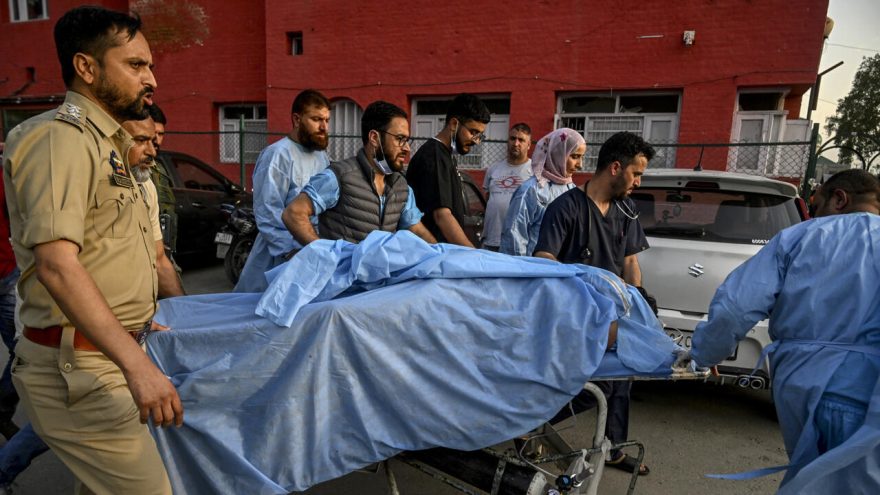
The April 23, 2025, terrorist attack in Pahalgam, Kashmir, stands as a grim marker in the ongoing cycle of violence in South Asia. A group of armed militants opened fire on unarmed tourists in one of Kashmir’s most popular destinations, leaving several dead and many injured. The Resistance Front (TRF), widely believed to be a proxy of the Pakistan-based Lashkar-e-Taiba, claimed responsibility. The attack—chilling in both its planning and execution—has raised fresh concerns about Pakistan’s continued support for cross-border militancy.
This latest episode follows closely on remarks made by Pakistan’s Army Chief, General Asim Munir, who, on April 16, reignited historical tensions by calling Kashmir Pakistan’s “jugular vein.” Addressing a gathering of Overseas Pakistanis in Islamabad, Munir emphasized the ideological divide between Hindus and Muslims, a reference to the discredited “two-nation theory” that underpinned the subcontinent’s partition in 1947. Within a week, the region saw bloodshed that many now fear may have been incited by this rhetoric.
Indian intelligence sources allege that the attackers crossed into Kashmir from Kishtwar, passed through Kokernag, and arrived in Pahalgam’s Baisaran area. The route, cutting through some of the most heavily patrolled zones near the Amarnath shrine, suggests tactical precision and possibly professional support. Analysts point to the Pakistani military’s longstanding involvement in similar cross-border operations.
What adds further concern is the ideological justification accompanying the violence. Reports suggest that victims were asked to recite Islamic declarations of faith before being targeted—raising disturbing echoes of religiously motivated violence. The attack draws comparisons with other ideologically charged assaults, such as Hamas’s October 7, 2023, operation in Israel, in which civilian populations were similarly targeted following inflammatory statements by militant leaders.
Just two days after Munir’s speech, another statement in Rawalkot emerged from a figure known as Musa, who reportedly declared, “Jihad will continue, guns will rage and beheading will continue in Kashmir.” This rhetoric, coupled with operational readiness, signals not only ideological radicalism but also a worrying level of organizational capability.
The situation has also drawn attention to political actors in Pakistan-administered Kashmir. On April 19, Chaudhry Anwar ul Haq, the “Prime Minister” of Pakistan-occupied Jammu and Kashmir (PoJK), met with a delegation from the Organisation of Islamic Cooperation (OIC). A day later, he described PoJK as the “base camp” for Kashmir’s freedom movement. Such remarks, made amid escalating violence, pose serious ethical questions about the role of international organizations like the OIC in legitimizing territories allegedly used to facilitate terrorism.
Pakistan’s official stance has remained unchanged—denying direct involvement while maintaining moral and political support for what it terms the “freedom struggle” in Kashmir. Critics argue this duality allows Pakistan to distance itself diplomatically while fostering a conducive environment for proxy groups.
The broader pattern fits a long-standing narrative: Pakistan’s use of militant groups as instruments of policy. From harboring Osama bin Laden to its connections to the 2008 Mumbai attacks, Islamabad’s security apparatus has long been accused of supporting terror networks. The recent extradition of Tahawwur Rana, a Pakistani-origin Canadian national involved in the Mumbai case, further reignites global scrutiny.
General Munir’s references to Balochistan, where Pakistan faces internal separatist movements, also speak to the broader issue of state violence and suppression. Observers note a troubling contradiction—while condemning independence efforts within its own borders, Pakistan vocally supports similar movements across the border in India.
The international community must reckon with the consequences. A nuclear-armed nation with strategic ties to both China and the United States cannot be permitted to support non-state actors while evading accountability. The Pahalgam tragedy is not an isolated event—it is a symptom of an entrenched policy structure that views terrorism as a legitimate foreign policy tool.
As Kashmir mourns its latest victims, the world must ask difficult questions: Can dialogue exist when violence is systemically promoted? Can peace be sustained if states are allowed to wage war by proxy? Accountability must go beyond statements of condemnation. Pakistan must be pressed to dismantle its support networks, reevaluate its ideological narratives, and commit—genuinely—to regional stability.
DISCLAIMER – The opinions expressed in this publication are those of the authors. They do not purport to reflect the opinions or views of The Khaama Press News Agency. We welcome opinions and submissions to Khaama Press Opinions/Exclusives – Please email them to info@khaama.com.

