


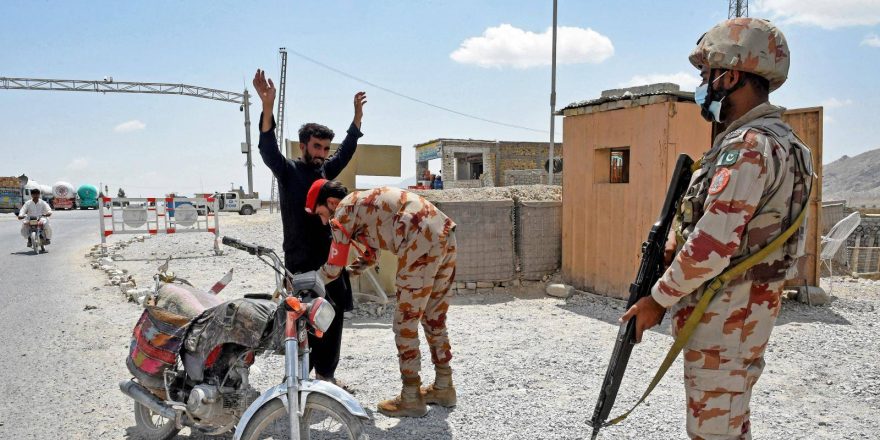
On the first anniversary of Operation Herof, Pakistan stands at a difficult crossroads, grappling with worsening security challenges in Balochistan and Khyber Pakhtunkhwa while attempting to project an image of stability to foreign investors. The insurgent campaign launched by the Baloch Liberation Army (BLA) on August 25, 2024, exposed the fragility of Pakistan’s internal security, even as Islamabad has pursued reforms aimed at fostering openness to international investment.
Operation Herof, named after the Balochi word for “Black Storm,” marked one of the most significant escalations in separatist violence in the country’s history. Hundreds of BLA fighters, including elite members of the Majeed Brigade and Fateh Squad, mounted coordinated assaults across 14 districts of Balochistan. Targets included police stations, military outposts, and vital economic infrastructure such as bridges, pipelines, and highways. In one of the most striking incidents, a female suicide bomber detonated an explosives-laden vehicle at the Bela military base, enabling insurgents to occupy the facility for nearly a full day. Elsewhere, militants blocked major routes, set fire to mineral convoys, and sabotaged railway lines, demonstrating their capacity to disrupt both security operations and economic activity.
The offensive carried symbolic weight as well. By linking it to the anniversary of Nawab Akbar Bugti’s assassination, the BLA emphasized its connection to decades of Baloch nationalist struggle. The scale and sophistication of Operation Herof represented the largest coordinated armed action since the early 2000s and revealed a growing operational capability within separatist networks.
One year later, the security environment remains highly volatile. Pakistan ranked second globally in the 2025 Global Terrorism Index, with terrorism-related deaths increasing by 45 percent to 1,081, the highest level in a decade. In the first half of 2025 alone, 502 attacks caused 737 fatalities and nearly 1,000 injuries, most of them concentrated in Khyber Pakhtunkhwa and Balochistan. The persistence of the Tehreek-e-Taliban Pakistan, alongside separatist groups in Balochistan and tense border dynamics with Afghanistan and India, has compounded the instability.
Against this backdrop, Pakistan’s efforts to court investors have yielded only modest results. Data from the State Bank of Pakistan shows that Foreign Direct Investment for the 2025 fiscal year reached $2.46 billion, only a slight increase from $2.35 billion the year before. While inflows rose by over 27 percent in June 2025 compared with June 2024, outflows also climbed dramatically by more than 160 percent, signaling continued caution among investors. Portfolio investments registered a sharp reversal, shifting from a small inflow last year to an outflow of $42.9 million. Overall foreign private investment declined from $209.2 million in June 2024 to $163.7 million in June 2025, while total foreign investment fell by more than half during the same period.
The volatility reflects a direct correlation between security conditions and economic performance. Investors remain deeply concerned not only about militant violence but also about state-imposed restrictions, including internet blackouts, curfews, and arbitrary detentions, which obstruct business operations, logistics, and workforce mobility. Repeated attacks on infrastructure linked to the China-Pakistan Economic Corridor have unsettled Chinese and other foreign partners, driving up insurance costs, delaying projects, and prompting renegotiations.
Civil society voices inside Pakistan argue that the state’s reliance on heavy-handed security measures often perpetuates cycles of violence. Indiscriminate operations and punitive tactics risk further alienating local populations, weakening state legitimacy, and eroding investor confidence. International risk assessments consistently flag the dual challenge of terrorism and state overreach as central obstacles to stability and investment.
As Pakistan reflects on the first anniversary of Operation Herof, the broader picture is one of persistent fragility. Without a coherent strategy that addresses both security imperatives and the political roots of insurgency, the country risks deepening its isolation in global markets. Temporary military gains are unlikely to suffice. What will be required is a combination of credible reforms, inclusive governance, and targeted development to address the drivers of conflict. Only then can Pakistan hope to restore investor trust and redirect its trajectory towards stability and growth.
Disclaimer: The views and opinions expressed in this article are those of the author and do not necessarily reflect the editorial policy of Khaama Press.

